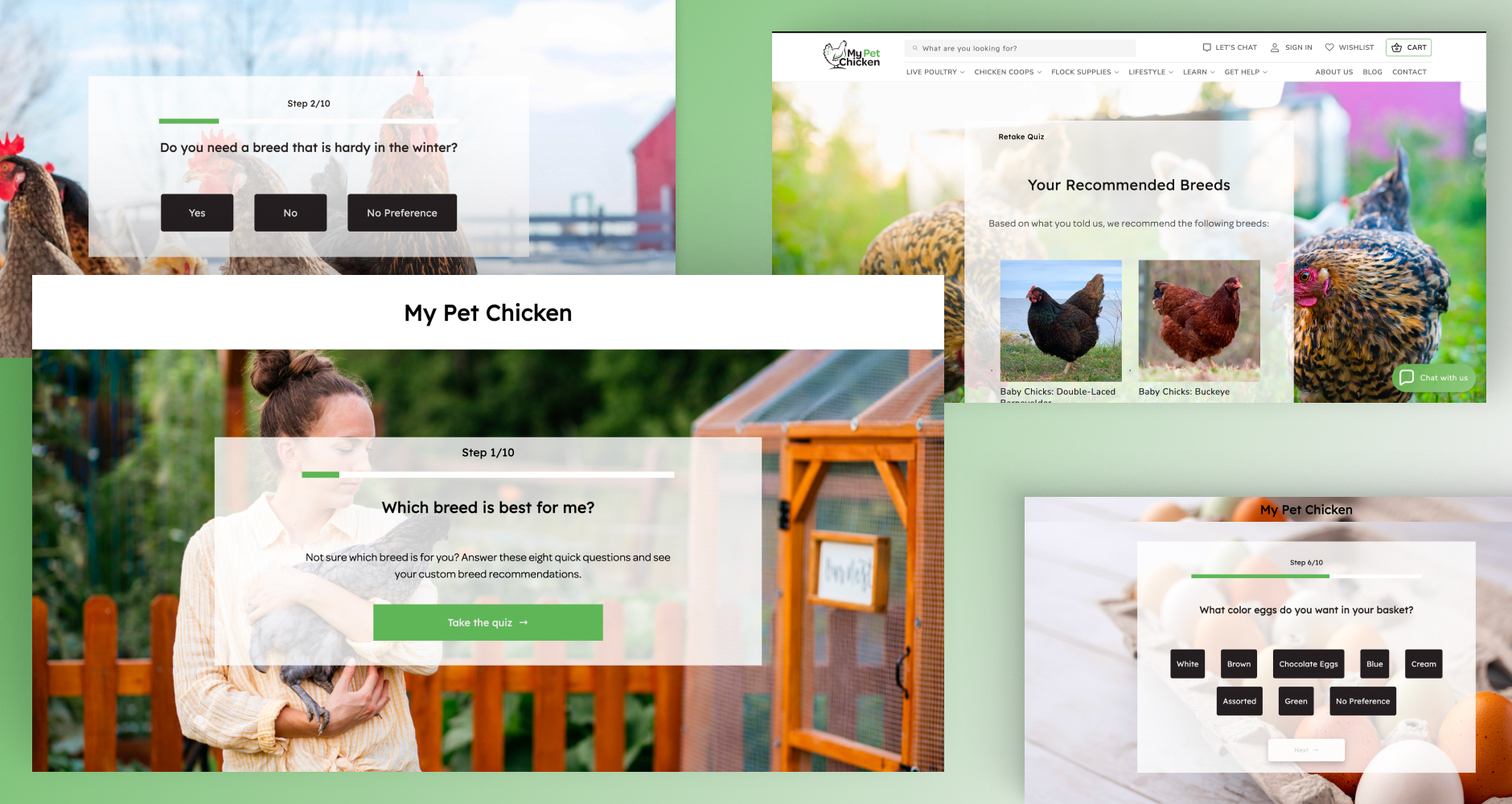
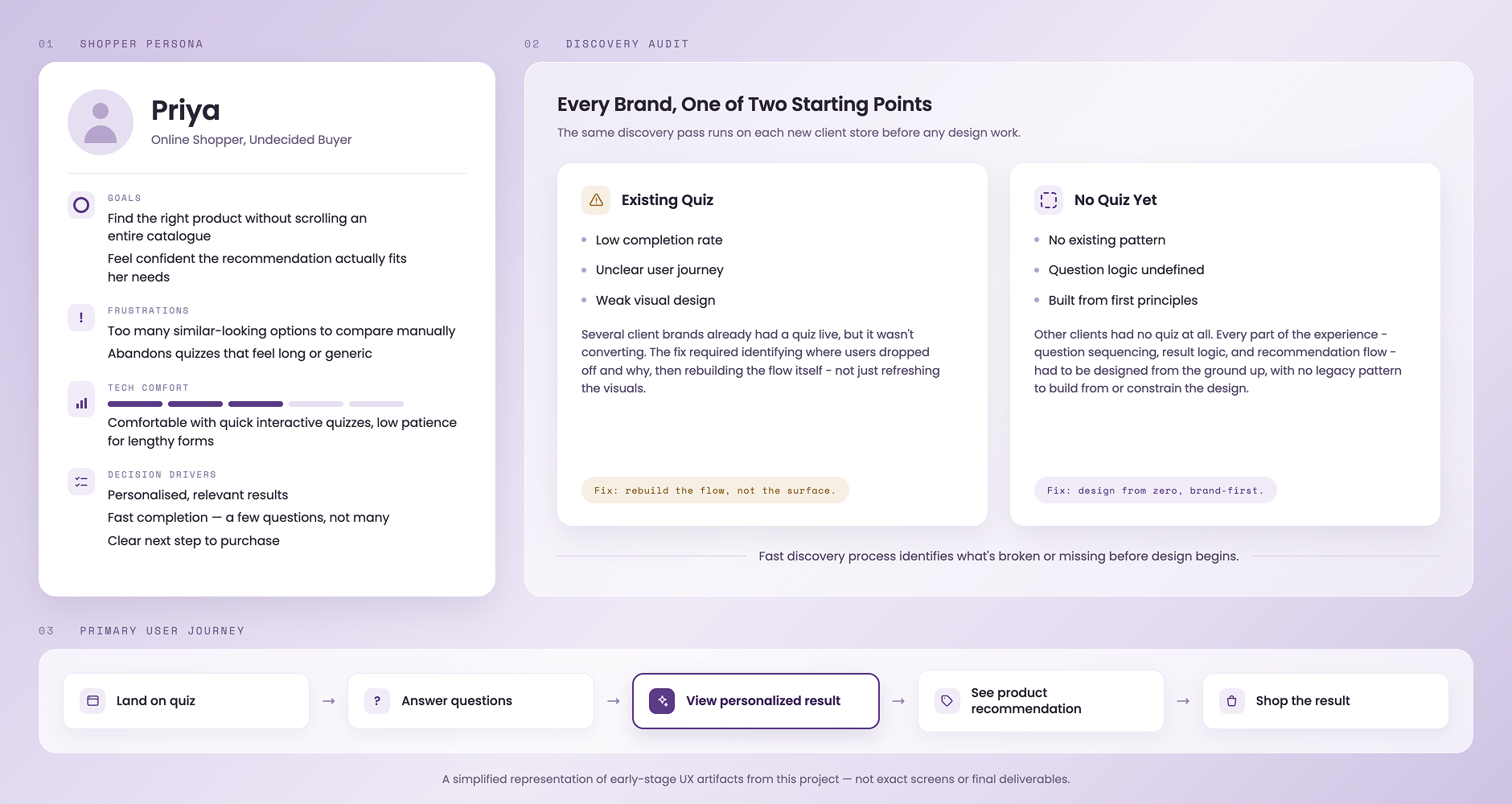
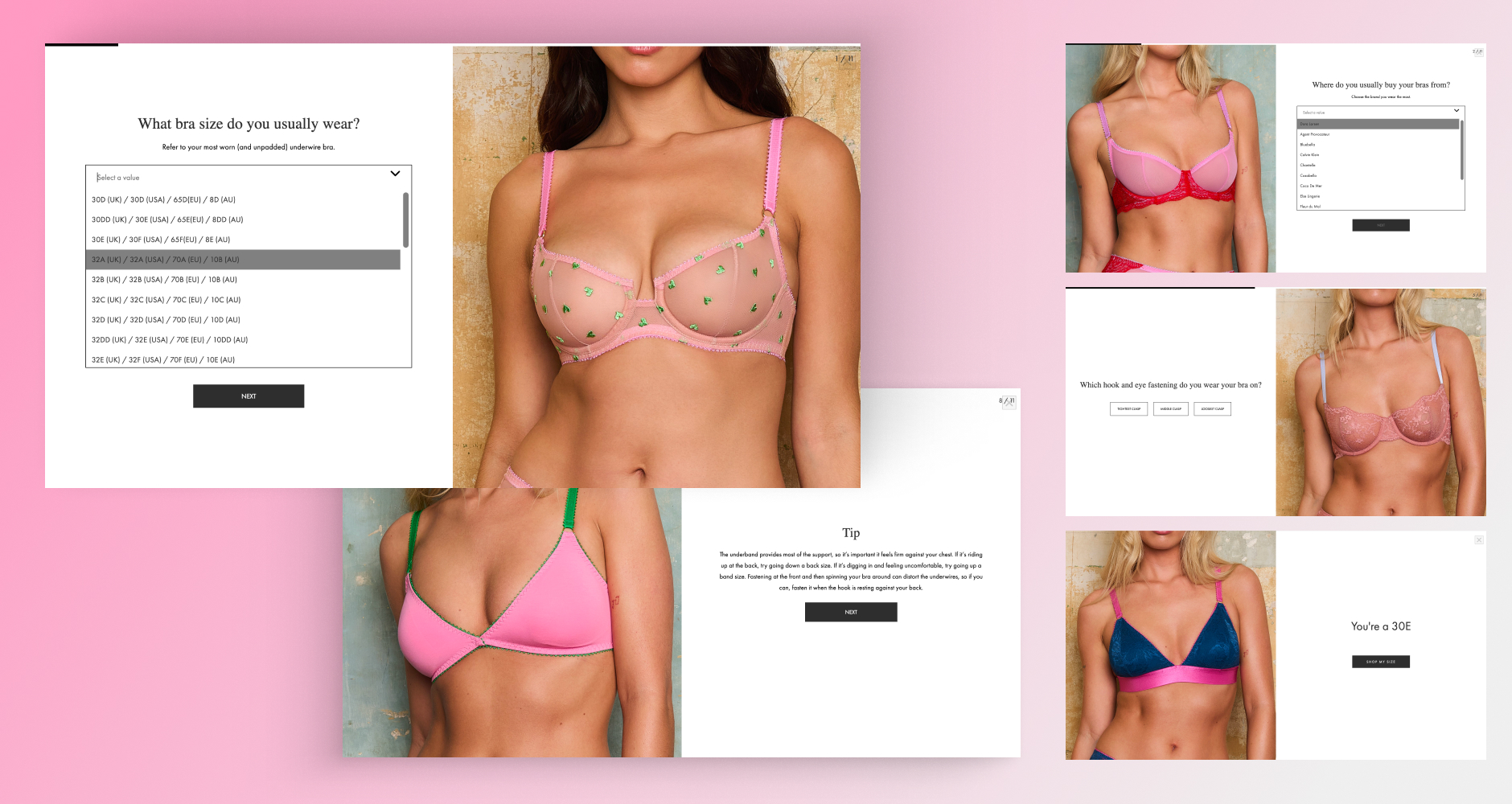
Every client brand came with its own business goals, customer behaviours, and product catalogue, which meant no single quiz template could work across all of them. Some brands had quizzes already live but underperforming, suffering from low completion rates, unclear user journeys, and poor conversion. Others needed a quiz built from zero, with no existing pattern to design from. Every new brand also meant learning a different industry fast enough to identify what was actually broken or missing before designing the fix.
I designed brand-specific quiz logic for each client instead of stretching one template across every case - diagnosing and rebuilding underperforming quizzes at the flow level, not just visually, while designing entirely new experiences from first principles wherever nothing existed yet. A fast discovery process let me ramp up on each new industry quickly, and every quiz was delivered fully responsive across devices.
The result: 45% higher completion on rebuilt quizzes, a 30% lift in conversion through brand-specific recommendation logic, and 10+ quizzes shipped across international Shopify brands - proving the approach was repeatable at scale, not a one-off success, while holding consistent quality across genuinely different industries.
Every client brand came with its own business goals, customer behaviours, and product catalogue, which meant no single quiz template could work across all of them.
01
No one-size-fits-all solution.
Each brand's audience and purchase logic were different enough that a generic quiz format would underperform for most of them.
02
Underperforming existing quizzes.
Several clients already had quizzes live, but they suffered from low completion rates, unclear user journeys, weak visual design, and poor conversion, meaning the fix wasn't cosmetic, it required rethinking the flow itself.
03
Quizzes built from zero.
Other clients had no existing quiz at all, requiring the experience to be designed from first principles, from question logic through to result and recommendation.
04
Fast domain ramp-up required.
Each new brand meant learning a different industry, audience, and product catalogue quickly enough to identify what was actually broken or missing before designing the fix.
The challenge across every brand was the same underneath the surface: understand the business fast, find what was stopping users from completing the quiz, and design an experience confident enough to turn a quiz result into a purchase.
My Role & Responsibility
I led the design and delivery of quiz experiences across multiple Shopify brands:
Led the end-to-end design and delivery of product recommendation quizzes
Designed responsive quiz experiences for desktop, tablet, and mobile devices
Revamped existing low-performing quizzes to improve usability and conversions
Created new quiz experiences from scratch based on business goals and customer needs
Built quizzes using AskWhai (Visual Quiz Builder)
Collaborated directly with clients, developers, and cross-functional teams throughout the project lifecycle
Supported implementation through HTML, CSS, and SCSS enhancements
Conducted testing and quality assurance to ensure a seamless user experience
UX Process
01
Research
Gathered requirements from clients and internal stakeholders.
Reviewed existing quiz experiences and analyzed usability issues.
Identified drop-off points and conversion barriers.
Studied customer behavior and product selection journeys within each domain.
02
Define
Defined business objectives and success metrics.
Mapped user journeys and recommendation logic.
Structured quiz flows to balance engagement and completion rates.
03
Ideate
Explored multiple interaction patterns and question formats.
Developed conversion-focused approaches for different audiences.
Optimized information flow to reduce friction and cognitive load.
04
Design
Created wireframes and high-fidelity UI designs in Figma.
Designed responsive experiences for desktop, tablet, and mobile.
Developed visually engaging interfaces aligned with each brand's identity.
05
Build & Prototype
Implemented quiz experiences using AskWhai Visual Quiz Builder.
Added custom HTML, CSS, and SCSS enhancements when required.
Worked closely with developers to integrate quizzes into Shopify stores.
06
Testing & Optimization
Conducted manual testing and quality assurance.
Validated recommendation logic and user flows.
Refined experiences based on stakeholder and user feedback.
The Solution
Designed brand-specific quiz logic instead of a generic template.
Question flow, product matching, and recommendation logic were built around each brand's actual audience and purchase behaviour, not a reusable format stretched across every client.
Diagnosed and rebuilt underperforming quizzes at the flow level, not just visually.
For brands with existing low-completion quizzes, the fix started with identifying where users dropped off and why, then rebuilding the user journey itself alongside the visual design, addressing the root cause rather than just refreshing the UI.
Designed entirely new quiz experiences from first principles.
For clients with no existing quiz, built question logic, result screens, and recommendation flows from the ground up, with no legacy pattern to constrain the design.
Developed a fast discovery process to ramp up on each new industry.
Before designing any quiz, quickly mapped each brand's audience, product catalogue, and purchase logic to identify what was actually missing or broken, allowing consistent quality across genuinely different domains without a generic playbook.
Delivered fully responsive quiz experiences
Delivered fully responsive quiz experiences across devices, ensuring completion rates weren't undermined by usability issues on mobile, where most quiz traffic typically originates.
Launched 10+ quizzes across multiple Shopify brands
Launched 10+ quizzes across multiple Shopify brands, optimizing question flow, recommendation logic, and content hierarchy throughout to increase both engagement and conversion.
Outcome & Impact
Higher Completion on Rebuilt Quizzes
45%
For brands with existing quizzes suffering from low completion, rebuilding the flow itself, not just the visuals, raised completion rates by 45%, proving the fix addressed the actual drop-off points rather than surface polish.
Lift in Conversion Through Brand-Specific Logic
30%
Designing question flow and recommendation logic around each brand's real audience and purchase behaviour, instead of a shared template, improved product conversion by 30% across brands with very different customers.
New Quiz Experiences Built With Zero Legacy Debt
For clients starting from nothing, quizzes were designed from first principles rather than adapted from an existing pattern, giving those brands a purpose-built experience instead of a retrofit.
Consistent Quality Across Genuinely Different Industries
A fast discovery process for each new brand meant quality held steady whether the client sold beauty products or hardware, proving domain speed didn't come at the cost of relevance.
Quizzes Shipped Across International Shopify Brands
10+
Delivered at this range and scale, the approach proved repeatable, not a one-off success, across multiple markets and product categories.
Learnings
Gained depth in multi-step quiz UX
Quiz UX is deceptively nuanced - question sequencing, progress indication, and result logic all directly affect completion rates and perceived value
Learned to lead redesigns with data, not assumptions
Revamping underperforming quizzes taught me to lead with data: identifying drop-off points before redesigning ensured changes were targeted, not cosmetic
Sharpened context-switching across parallel brand projects
Working across several different brands in parallel sharpened my ability to context-switch rapidly while keeping each brand's tone and visual identity distinct
Improved async communication across time zones
Direct client collaboration across time zones improved my written communication and async feedback skills - clarity in documentation became as important as clarity in design
Closed the gap between design intent and browser reality
Hands-on HTML/CSS/SCSS work during implementation gave me a much deeper appreciation for the gap between design intent and browser reality, and how to close it
Learned to design creatively within platform constraints
Building quizzes inside a no-code tool (AskWhai) taught me to design within platform constraints creatively, finding workarounds that preserved UX quality
Learned to treat responsive design as an ongoing consideration
Testing across devices and browsers reinforced that responsive design is not a final step but an ongoing consideration woven throughout the design process